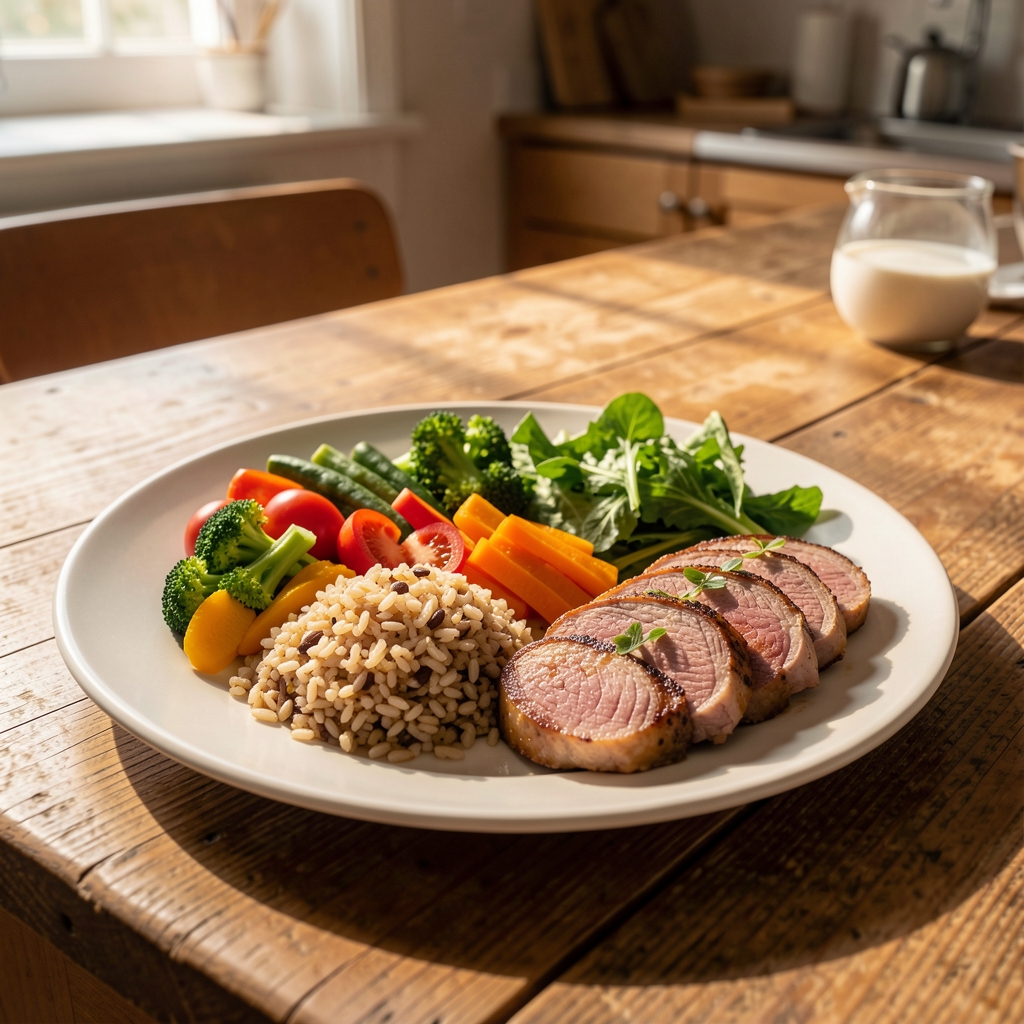
The proportional composition of a daily meal plate is not a matter of preference — it is a quantifiable arrangement of food categories whose ratios have been studied and documented across decades of nutritional research. What follows is a structured account of how those proportions function in a home-kitchen context, and why the documentation of them matters for sustained, evidence-based eating.
The Standard Proportional Framework
The most widely referenced dietary framework for plate composition — derived from published nutritional guidelines issued by bodies including the NHS Eatwell Guide — divides a standard meal plate into three primary zones: vegetables and fruit occupying approximately half the plate surface, starchy carbohydrates occupying a third, and protein sources occupying the remainder. This arrangement is not arbitrary; it reflects the energy density and micronutrient yield of each food category relative to volume.
Vegetables and fruit, at the 50% threshold, contribute the highest micronutrient density per calorie. Leafy greens, brassicas, root vegetables, and legumes each supply distinct vitamin and mineral profiles — a point often underappreciated when a plate is composed entirely of a single vegetable variety. The fibre content of this zone also contributes to satiety signalling, slowing gastric transit and moderating post-meal energy fluctuation.
Starchy carbohydrates — including whole grains, potatoes, rice, and bread — form the structural energy base of the plate. The NHS Eatwell Guide specifically recommends wholegrain variants, which carry a substantially higher fibre load than refined equivalents. Brown rice, oats, whole wheat pasta, and seeded bread all fall into this category. Their contribution to sustained energy availability across a working day is documented in peer-reviewed nutritional literature.
"The plate is not merely a delivery system for calories — it is a compositional document. Its arrangement reflects an informed decision about nutrient priority."
Eleanor Marsden — Taronel Notebook, January 2026
Protein Category: Composition and Selection
The protein zone of the plate — approximately 15–20% by surface area in the standard framework — encompasses both animal and plant sources. Lean meats, fish, eggs, pulses, tofu, and dairy products each carry distinct amino acid profiles. The completeness of a protein source — the extent to which it supplies all nine essential amino acids in sufficient quantity — is a key selection criterion documented in published nutritional guidance.
Animal proteins, including white fish, poultry, and eggs, are considered complete protein sources. Plant proteins, including legumes and tofu, can achieve completeness through combination across a day's meals rather than within a single plate. A plate featuring lentils alongside whole grain bread, for instance, achieves a complementary amino acid profile across the meal.
The protein-to-fibre ratio within the plate is a secondary metric worth tracking. High-fibre protein sources — lentils, chickpeas, edamame — deliver both macronutrient categories simultaneously, a characteristic that influences post-meal satiety more durably than equivalent caloric quantities of low-fibre protein alternatives. This is not a minor distinction; the meal satisfaction index across a four-hour post-meal window differs measurably between these two protein categories.
- 01Vegetables and fruit should occupy approximately half the plate surface — variety across colour families improves micronutrient breadth.
- 02Wholegrain starchy carbohydrates provide sustained energy availability over 3–4 hours; refined equivalents peak faster and shorter.
- 03High-fibre protein sources (lentils, chickpeas) deliver extended satiety compared to equivalent caloric quantities of low-fibre protein.
- 04Portion assessment by plate surface area is more practical than gram-weight measurement for a consistent home kitchen approach.
- 05Small portions of healthy fats — olive oil, nuts, avocado — are not accounted for in the three-zone model but contribute measurably to micronutrient absorption.
Portion Assessment Without Scales
A recurring practical challenge in balanced plate composition is the absence of a kitchen scale in most home cooking environments. Gram-weight measurement, while precise, is not a workflow that integrates naturally into the preparation of three meals daily. A more durable approach — one documented in several published dietary behaviour studies — relies on visual and hand-reference assessment.
The palm-reference system assigns each food category a portion size relative to the dimensions of the individual's hand. A protein portion equates approximately to the palm area (excluding fingers). A cupped hand represents a carbohydrate portion. A fist approximates a vegetable serving. A thumb-length portion applies to fats. These are not precise measurements — they are calibration anchors for consistent estimation across meals, which nutritional behaviour research suggests is more valuable for long-term eating pattern maintenance than occasional precision.
Applied to the three-zone plate model, this system translates to a practical daily assembly routine: two fist-sized vegetable portions plus one fruit serving; one palm of protein; one cupped carbohydrate portion; and a thumb of fat. The resulting calorie range falls between 450 and 650 per main meal for the average adult, consistent with standard published intake guidance for weight maintenance.
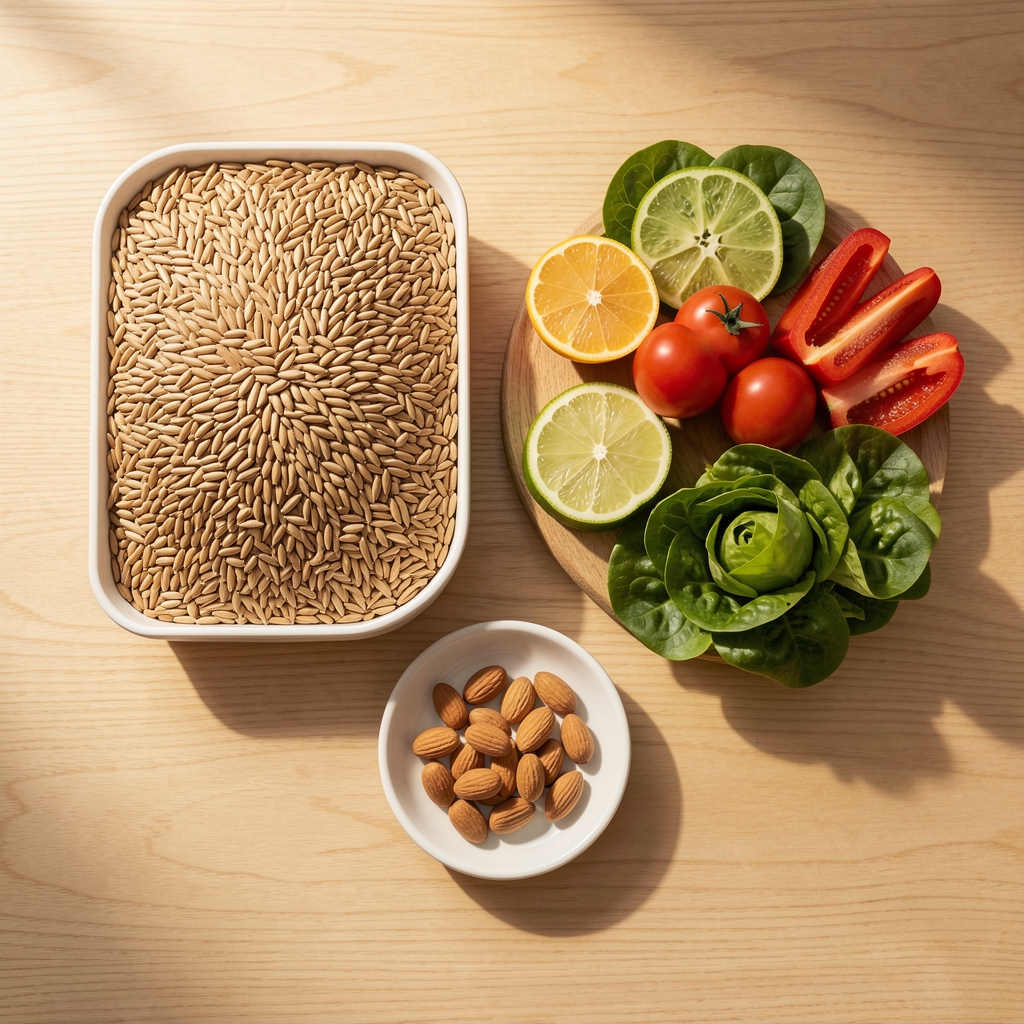
Visual breakdown of a standard three-zone plate composition for a main meal — categorised by macronutrient group.
Calorie Awareness as Context, Not Constraint
Calorie awareness — the practised understanding of approximate energy content across food categories — functions as a contextual tool rather than a daily counting exercise. The distinction is important. Studies of eating pattern sustainability consistently show that rigid caloric accounting is associated with lower long-term adherence, while structural plate composition habits — the proportional zone approach — are associated with more durable eating behaviour change.
Understanding that a tablespoon of olive oil contributes approximately 120 kcal, while a cup of cooked lentils contributes approximately 230 kcal with an additional 16g of fibre, equips a home cook to make compositional decisions without active calculation. This is the operative mode of calorie awareness — an internalised reference library that informs ingredient selection without dominating the cooking experience.
The energy density differential between food categories is the most practical application of this awareness. Vegetables carry approximately 20–40 kcal per 100g; lean protein sources 100–170 kcal per 100g; cooked whole grains 130–180 kcal per 100g; nuts and seeds 550–650 kcal per 100g. Knowing these broad bands enables a cook to build a nutritionally sufficient, calorically appropriate plate without measurement, by adjusting volumes based on category rather than ingredient.
Micronutrient Breadth: The Case for Colour Variety
The vegetable and fruit zone of the balanced plate is most nutritionally productive when it encompasses a range of colours across the weekly menu. This is not a stylistic observation — it is a biochemical one. The pigment compounds responsible for the distinctive colours of plant foods correspond to specific families of micronutrients: carotenoids in orange and yellow produce, anthocyanins in red and purple plants, chlorophyll compounds in dark greens, and sulphur-containing glucosinolates in cruciferous vegetables.
A weekly menu constructed around a single vegetable category — say, predominantly green leafy vegetables — will supply excellent folate and iron but will underrepresent the carotenoid family. Adding roasted sweet potato, carrots, or red peppers to the rotation addresses this gap without requiring supplementary sourcing. The practical implication for grocery planning is straightforward: at least three distinct colour categories in the weekly vegetable selection is a reasonable minimum for broad-spectrum micronutrient coverage.
Seasonal produce rotation, discussed at greater length in the second article of this series, facilitates this colour diversity naturally. Spring offerings — asparagus, peas, radishes — differ in pigment profile from autumn's root vegetables and winter's brassicas. A cook who follows seasonal availability will, as a by-product of procurement, rotate through the colour spectrum across the year with minimal additional planning.
Editorial Note — This article draws from published nutritional guidelines including the NHS Eatwell Guide and peer-reviewed research on dietary behaviour. It represents editorial observation, not professional nutritional guidance. Readers with specific concerns about their daily routines are encouraged to speak with a qualified wellness professional.